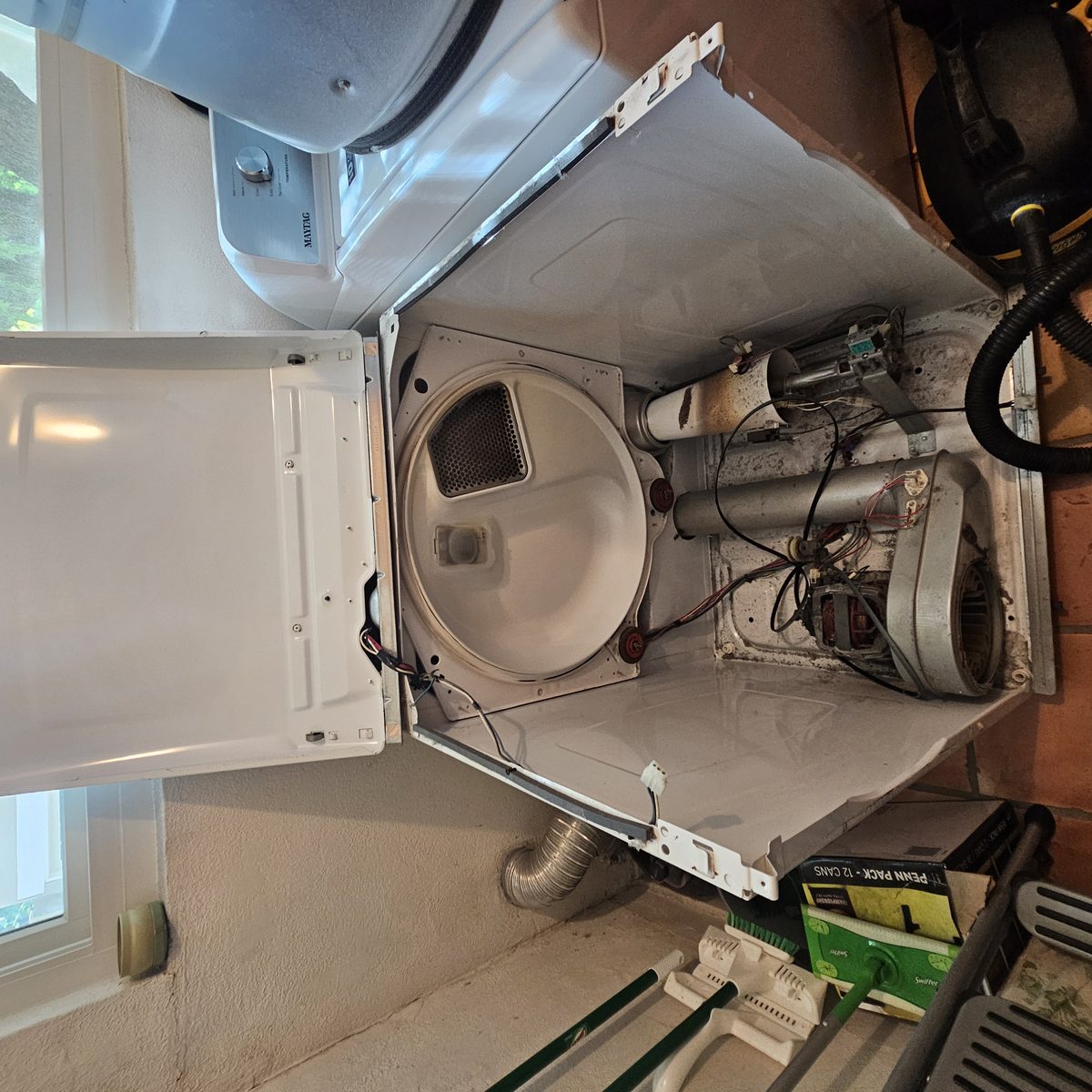
Introduction
The drum turns, the timer counts down, and the towels come out soaked. A Maytag Bravos that tumbles but won’t dry is one of our most common calls.
That’s good news. A dryer that spins has already proven its motor, belt, door switch, and start circuit. The fault is trapped in the heating circuit, and that circuit holds only a handful of parts.
Los Angeles homes fail this way often. Long attic ducts, tight laundry closets, and lint-packed stucco wall caps all choke airflow, and choked airflow is what destroys thermal fuses and heating elements. At CityFix Appliance, our Los Angeles appliance repair specialists test the heating circuit in one fixed sequence. This guide follows it.
Quick Answer
Why does a Maytag Bravos dryer run but not heat?
A Maytag Bravos that spins without heat has one of five faults: a blown thermal fuse (usually from a clogged vent), a burned-out heating element, a restricted exhaust vent forcing an overheat shutdown, a failed cycling or high-limit thermostat, or a half-power supply with one dead 120V leg. Test airflow and power before buying parts.
Why Your Maytag Bravos Dryer Runs But Doesn’t Heat
An electric Bravos runs on 240 volts split into two 120V legs. The detail nobody explains: the motor, drum light, and control board draw from one leg. The heating element needs both. Lose a leg to a half-tripped breaker, loose neutral or corroded terminal, and the dryer tumbles a full cycle with no heat and no error code.
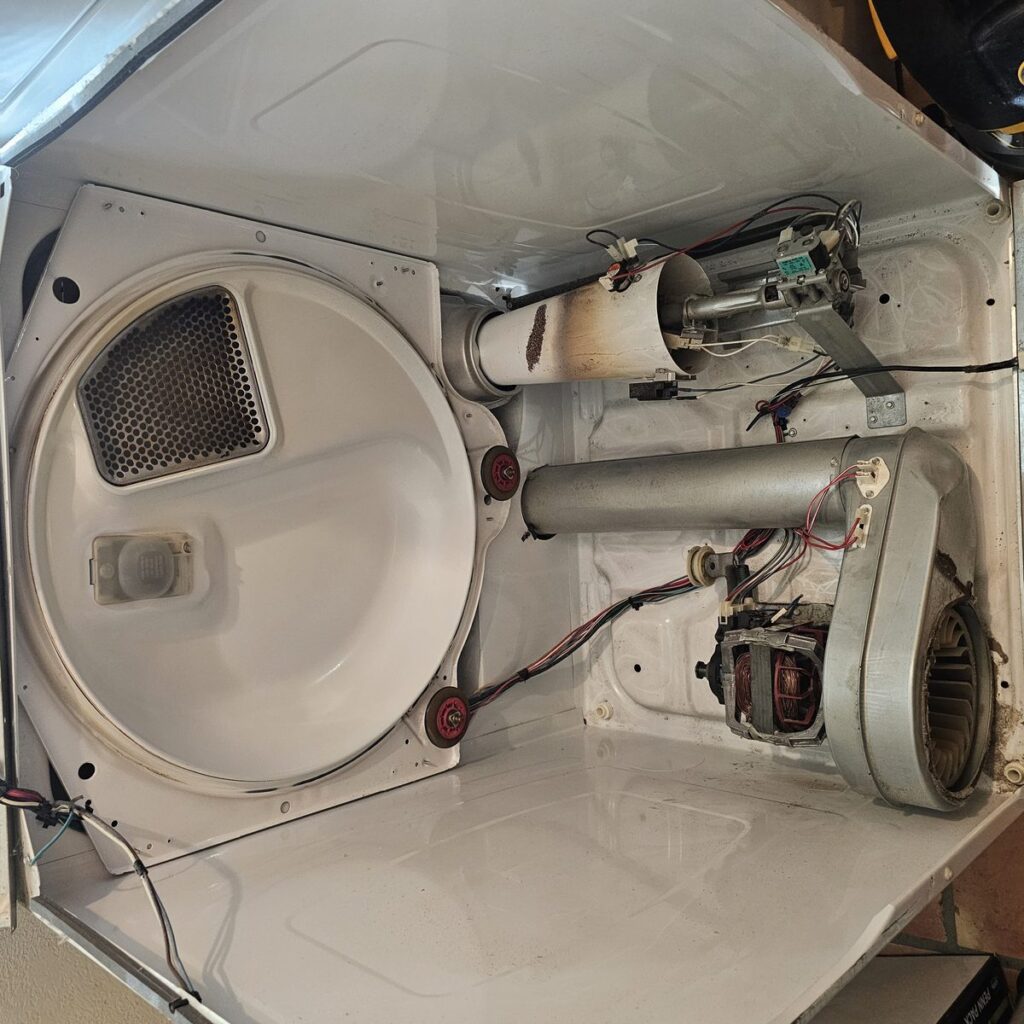
The heat path is a series circuit: thermal fuse → cycling thermostat → high-limit thermostat → heating element. Break it anywhere and heat stops dead while the drum keeps turning.
Those safety parts cut heat when exhaust temperature climbs too high, and it climbs when air can’t escape. That’s why airflow, not a defective part, is the root cause behind most no-heat repairs. Gas models work identically, with an igniter and gas valve replacing the element.
Before Replacing Any Parts
Six checks, fifteen minutes, no parts. They resolve a surprising share of no-heat calls.
- Breaker: a half-tripped double-pole 30A breaker looks normal. Switch it fully OFF, then ON; don’t trust a visual check.
- Voltage: the outlet should read ~240V hot-to-hot and 120V hot-to-neutral. Only 120V total means a lost leg: an electrical fault, not a dryer fault.
- Reset: cut power for five minutes to clear the control board.
- Lint screen: clean it, then pour water through. If the water beads or pools, softener residue has sealed the mesh. Scrub with dish soap.
- Exhaust vent: disconnect the duct and check for compacted lint at the elbow and wall cap. Outside, confirm the flap opens while the dryer runs.
- Settings: Air Fluff, Air Dry, and some Wrinkle Control cycles run without heat by design.
If the drum is struggling rather than the heat, that’s a different repair path; see dryer drum won’t turn and dryer drum is hard to turn by hand.
Symptom → Cause Table
| Problem | Possible Cause | What To Check |
|---|---|---|
| Runs but no heat | Blown fuse, dead element, or lost 120V leg | Outlet voltage; fuse and element continuity |
| No error code, no heat | Lost power leg or open safety part | 240V at outlet; fuse and high-limit continuity |
| Quits heating after 10–20 min | Restricted vent tripping the cycling thermostat | Vent run; wall cap airflow; sagging coils |
| Weak or lukewarm heat | Partly broken coil or intermittent leg | Element resistance; outlet terminals for heat damage |
| Very long drying times | Clogged screen, crushed duct, dirty sensor | Screen water test; duct behind dryer; sensor bars |
| No heat after a repair | Wire off a terminal, or vent never cleaned | Every spade connector; the full vent run |
Complete Diagnostic Workflow
Safety first: unplug the dryer before removing any panel. Every test below runs with power off and one wire lifted off the component.
- Power Supply: Meter the outlet: 240V hot-to-hot, 120V each hot-to-neutral. If a leg reads zero, repair the supply first. Inspect the cord terminal block for scorching, common in older LA houses.
- Airflow: Disconnect the duct, run high heat for two minutes, and feel the exhaust at the machine outlet. Strong air with the duct off but weak air with it connected points to the duct or wall cap.
- Thermal Fuse: On the blower housing. Lift one wire and probe both terminals. Near-zero ohms means intact; no reading means blown.
- Heating Element: Isolate the leads and read the resistance: 8–12 ohms is healthy; OL indicates an open coil. Probe each terminal to the housing; continuity there means the coil is grounding out.
- Thermostats: Test the cycling and high-limit thermostats the same way. Both should show continuity at room temperature. An open high-limit means the vent overheated the machine.
- Controls: If every test passes, the fault is the control board or the motor’s centrifugal switch, which must close before heat energizes. DIY ends here. If the dryer also won’t start reliably, see dryer won’t start but has power.
Maytag Bravos XL Thermal Fuse Guide
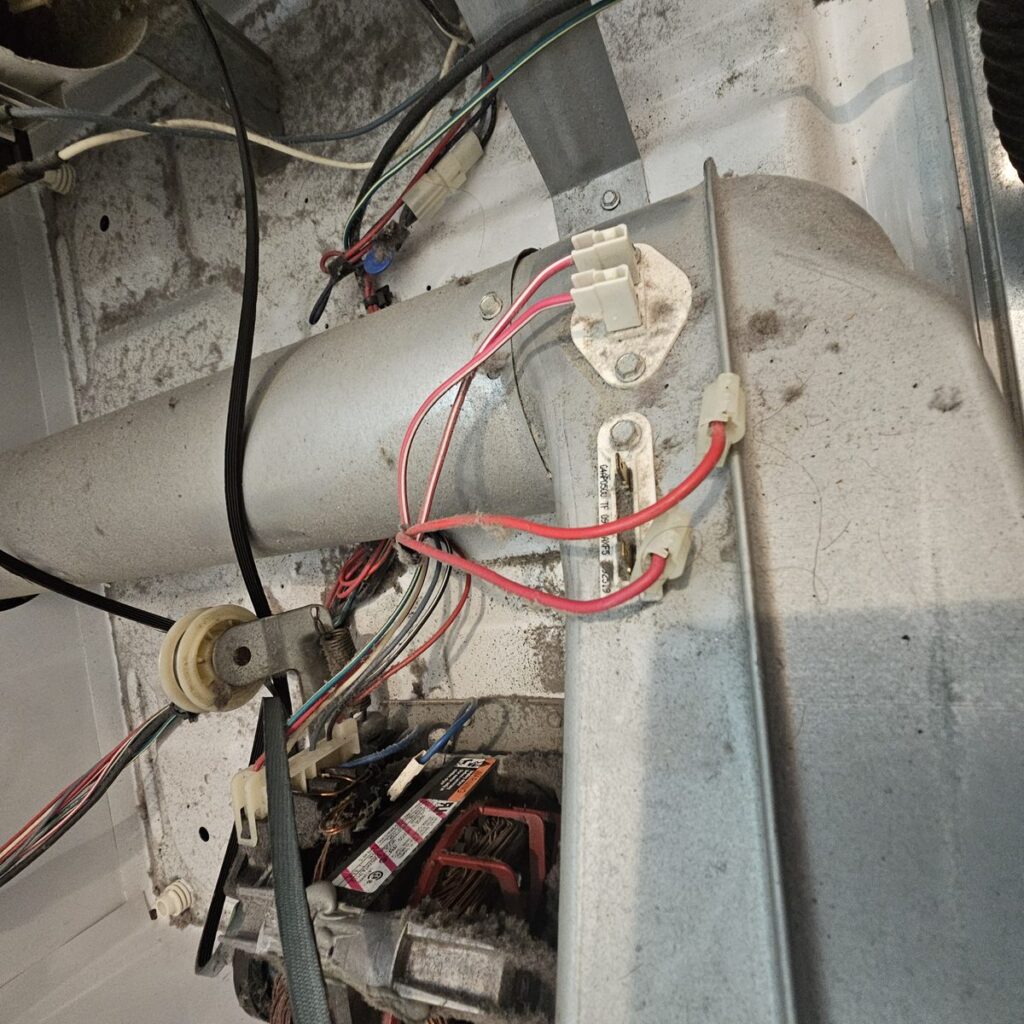
What it does. A one-shot safety device. When the exhaust air exceeds its rated temperature, it opens permanently, severing the heat circuit. It never resets.
Why it fails. Nine times out of ten, restricted airflow: compacted lint, a crushed transition hose, a bird nest in the wall cap, or an overlong duct run.
Location. On most Bravos and Bravos XL models, the blower housing is behind the rear access panel; some versions use the internal exhaust duct. Confirm against the Maytag Bravos dryer manual for your model number, printed on the door sill or behind the lint trap.
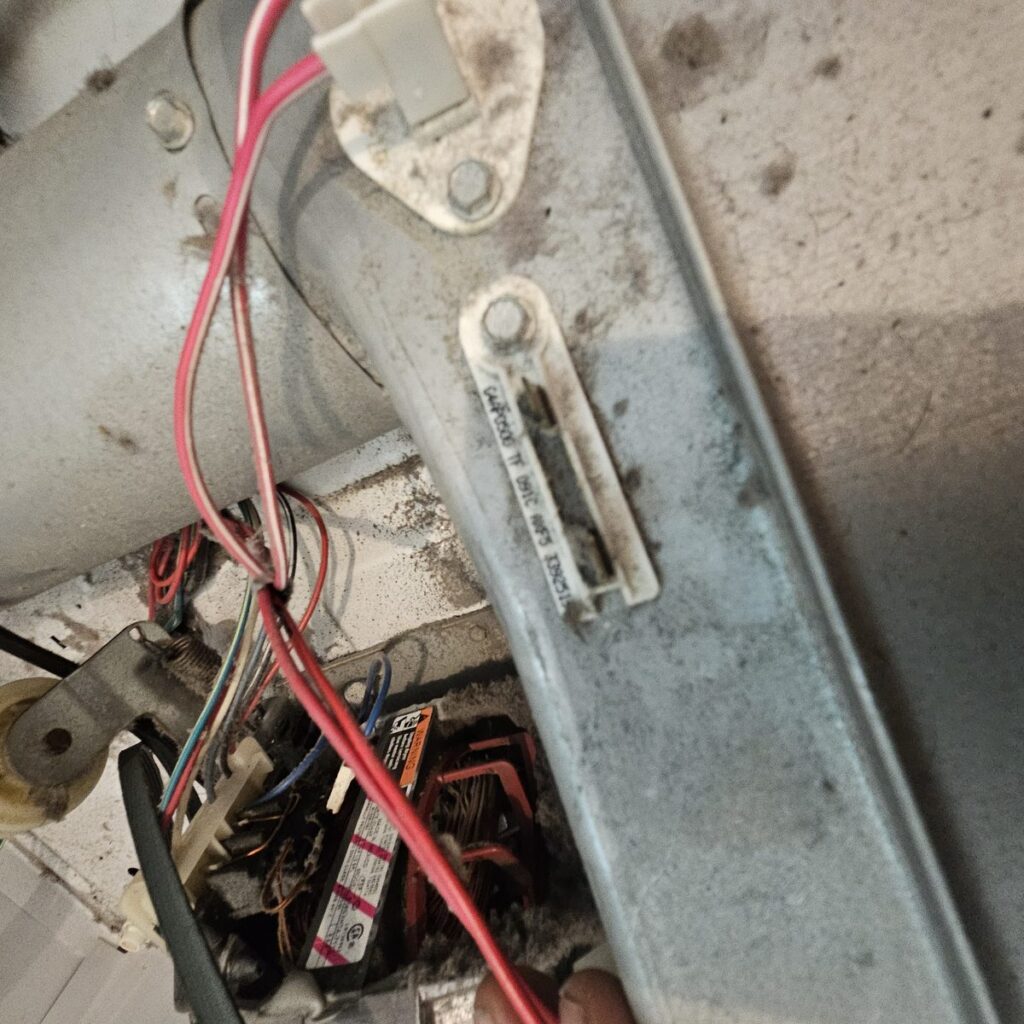
How to test. Unplug, remove the rear panel, lift one wire off the fuse, and check continuity across both terminals.
Mistakes we see constantly. Replacing the fuse without cleaning the vent; that buys a week. Bridging the fuse with a jumper wire: a fire hazard, never acceptable. Fitting the wrong temperature rating because the part looked identical. Overlooking the thermal cut-off near the element, which often fails in the same event.
Why it keeps blowing. Replaced it twice? The fuse isn’t the problem. The vent is still restricted, the blower wheel is packed or cracked, or a shorted element is driving heat nonstop. Fix the cause, not the symptom.
Maytag Bravos Heating Element Guide
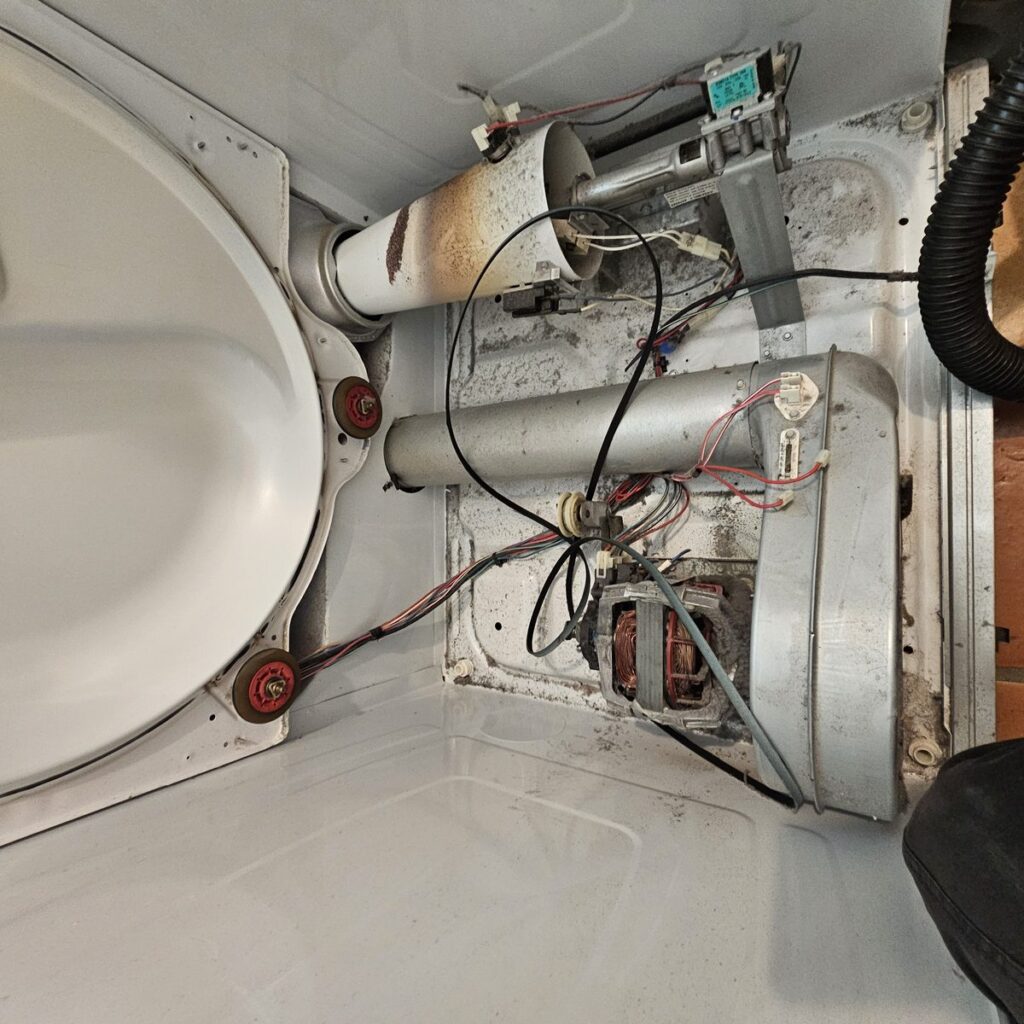
Symptoms. Full tumble, no heat, no error code, or weakened heat stretching drying times from 45 minutes to two hours.
Testing. With the element isolated, read resistance across the terminals. About 8–12 ohms is normal; OL means a broken coil, usually visible through the housing slots.
Maytag Bravos XL dryer heating element replacement. Unplug, remove the rear panel, and photograph the wire positions first. Disconnect the leads, back out the screw at the top of the element can, and slide the assembly free. Transfer the high-limit thermostat and thermal cut-off if the new part doesn’t include them. Reassemble, then confirm heat across a full cycle, not a 30-second test.
Why elements fail. Overheating from a blocked vent, lint packed inside the housing, age (most last 8–12 years), and short-cycling from a failing thermostat. Replacing an element in an older Maytag dryer is often worth it, but past the 15-year mark, with a tired blower and worn bearings, put the money toward a new machine.
Full Maintenance Guide
- Lint screen — every load. Clear it every time; water-test it monthly. A softener-glazed screen strangles airflow while looking spotless.
- Vent — twice a year. Disconnect the duct, run a rotary brush its full length, vacuum both ends, and swap foil hose for rigid metal duct.
- Cabinet interior — yearly. Pull the rear panel and vacuum lint from the element housing, wiring, and motor. That lint rests against a heat source.
- Blower housing — yearly. Inspect the wheel for packed lint and cracked hub blades. A weak blower overheats the machine like a clogged duct, and it’s invisible from outside.
- Moisture sensor — monthly. Wipe the two metal strips inside the drum with rubbing alcohol. Softener film insulates them, ending cycles on soaking clothes.
- Exterior vent cap — quarterly. With the dryer running, the flap should open on steady warm airflow. In Los Angeles, we clear bird nests and stucco dust from wall caps constantly.
LA homes accumulate lint faster than most: dryers run year-round, and the long attic ducts common in older houses trap far more lint than a short, straight run to an exterior wall.
FAQ
Why is my Maytag Bravos dryer running but not heating?
The motor runs on one 120V leg; the element needs the full 240V. So the drum spins perfectly while a blown fuse, failed element, open thermostat, or lost leg keeps the heat off.
Where is the thermal fuse located on a Maytag Bravos dryer?
On the blower housing, behind the rear access panel on most Bravos and Bravos XL models. Some versions use the internal exhaust duct; verify against your model-specific manual before ordering.
Does a Maytag dryer have a reset button?
Not for heat. Some models carry a motor overload reset, but no button restores heat. The real reset is cutting power for five minutes, and a blown thermal fuse never resets; it must be replaced.
Why does my dryer have no error code but no heat?
The two most common causes aren’t monitored by the control board. A lost 120V leg and an open thermal fuse both look normal to the dryer’s electronics. No code doesn’t mean no fault.
Can a clogged vent stop a Maytag dryer from heating?
Yes, it’s the leading cause. A restricted vent traps heat until the high-limit thermostat or fuse opens to protect the machine. Clean the vent before replacing anything.
Should I replace the heating element or thermal fuse first?
Neither; test both. Whichever reads open is your failed part. If the fuse is blown, clean the vent the same day or you’ll buy another within the week.
When to Call a Professional
Homeowners can safely handle the lint screen, vent cleaning, breaker check, wall cap inspection, and moisture sensor, a genuine share of no-heat cases- with just a screwdriver and a vent brush.
Call a technician when metering live 240V makes you uneasy, when a replacement fuse blows again, when the element tests good but heat never returns, when the outlet or cord shows scorching, or when evidence points to the control board. Gas models are a hard stop: igniter, gas valve, and flame sensor work belong with a licensed professional.
Still no heat after these checks?
CityFix Appliance provides Los Angeles appliance repair for Maytag Bravos and Bravos XL dryers, full heating-circuit diagnosis and vent airflow testing on the same visit, so the cause gets fixed alongside the part.
Final Summary
Diagnose before you spend. Confirm 240V at the outlet and real airflow at the wall cap, then meter the thermal fuse, element, and thermostats in that order. The component that reads open is your answer.
Maintenance makes the repair stick. Nearly every blown fuse and scorched element we replace traces back to a vent nobody cleaned. Twice-yearly vent cleaning and a monthly screen water test break that cycle.
When testing runs past your comfort level, bring in a professional. CityFix serves Los Angeles homeowners with diagnosis-first dryer repair, so your Bravos gets fixed once, not three times.