
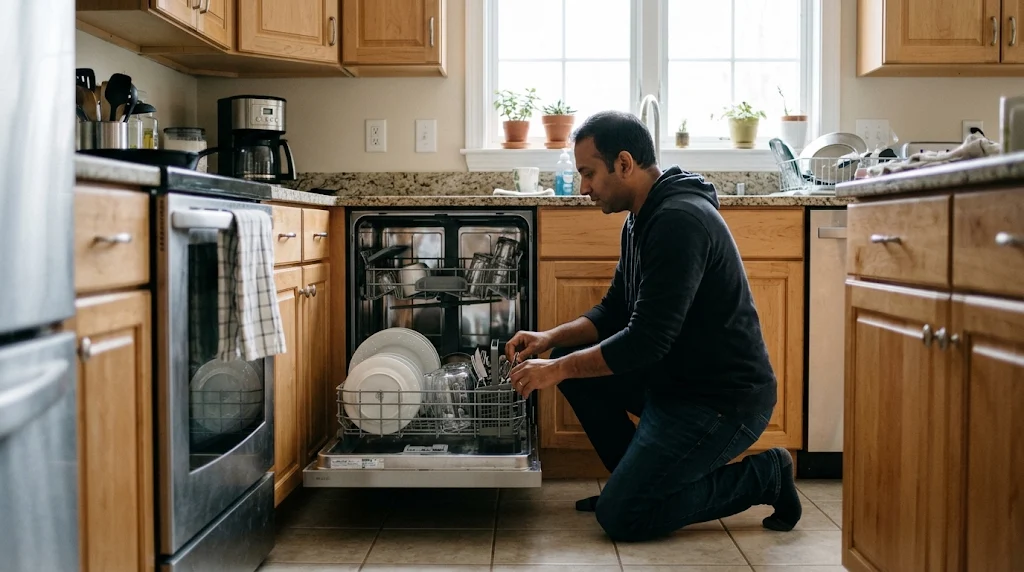
Quick answer: If your dishwasher is not cleaning dishes properly, clean the filter first. A clogged filter is the most common cause of gritty, dirty dishes, followed by blocked spray arm holes, water that is not hot enough, loading that blocks the spray arms or detergent door, and hard water film. Fix those five and most dishwashers clean well again. If dishes are still dirty after a full clean, a water inlet valve, circulation pump, or heater problem may need a technician.
When a dishwasher not cleaning dishes becomes a recurring headache, below is the exact diagnostic checklist our techs walk through in LA kitchens—starting with a quick symptom table so you can pinpoint the issue in under a minute, followed by the 11 causes we see most often and a 15-minute reset routine you can run right now.
When a dishwasher leaves grit, food, or cloudy film, it usually comes down to one of these common issues. Check them in this order before calling for service:
Dishwasher Not Cleaning? What the Residue Tells You
| What you see | Most likely cause | Homeowner or technician? |
|---|---|---|
| Gritty bits and food particles on dishes | Clogged filter or spray arm holes | Homeowner |
| White cloudy film or spots on glasses | Hard water, no rinse aid, too much detergent | Homeowner |
| Detergent pod or powder left in the dispenser | Dispenser door blocked or broken, cold water, rinse-only cycle | Homeowner first |
| Top rack dirty, bottom rack clean | Upper spray arm blocked or upper water supply problem | Homeowner first, then technician |
| Everything dirty, little or no water sound | Low water fill (inlet valve or float switch) | Technician |
| Fills and drains, but wash sounds weak | Circulation pump or wash motor | Technician |
| Greasy film, odor, standing water | Dirty filter, drain or interior buildup | Homeowner first, then technician |
| Dishes not hot at end of cycle, not drying | Heating element or thermostat | Technician |
Why Is My Dishwasher Not Cleaning Dishes? 11 Common Causes
1. Dirty or Clogged Filter
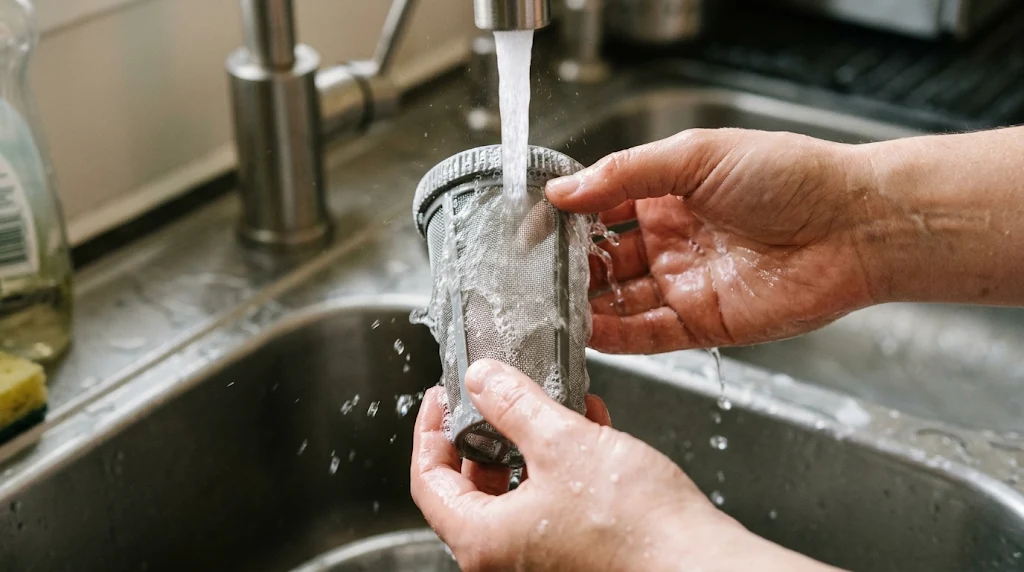
What’s going on: Almost every dishwasher built in the last 10 to 12 years ditched the loud built-in food grinder in favor of a quiet manual mesh filter. That filter sits right in the floor of the tub. Once grease, eggshells, and pasta bits pack into that screen, the pump has no choice but to spray dirty, gritty water right back onto your clean plates.
What to do: Slide out the bottom rack, twist the cylindrical filter counterclockwise, and lift out the flat mesh plate underneath. Rinse both under warm tap water and scrub them gently with an old toothbrush or soft nylon brush—skip wire brushes, which will poke holes straight through the screen. If the mesh feels slimy with grease, let it soak in warm soapy water or white vinegar for 20 minutes first.
2. Blocked Spray Arms
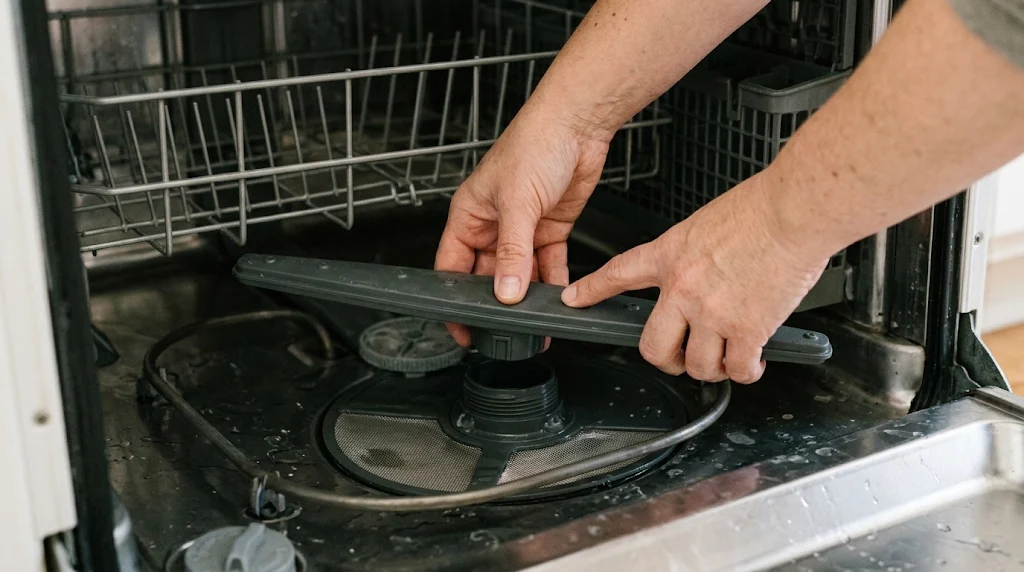
What’s going on: Your dishwasher cleans by water pressure, not soaking. Lemon seeds, paper jar labels, broken glass chips, and calcium scale from LA’s hard water love to wedge inside the tiny jets along the spray arms. Even two or three plugged holes on the tips of an arm can kill the water pressure needed to make it spin.
What to do: Unclip or unscrew both the lower and upper spray arms (on many models, the middle arm pulls straight off the upper rack track). Hold them under the faucet and poke each clogged hole clear with a wooden toothpick or bamboo skewer. If white mineral crust has built up inside, soak the arms in a 50/50 mix of warm water and white vinegar for half an hour. Snap them back in and give each one a spin by hand—it should glide smoothly without catching.
3. Dirty Tub, Gasket and Buildup
What’s going on: Even if you rinse the filter, grease and soap scum slowly coat the rubber door seal, the hidden lip along the bottom of the door, and the sump walls. As soon as hot water hits that buildup during the next wash, it breaks loose and leaves a greasy film or sour smell on your dishes.
What to do: Take a damp microfiber cloth dipped in warm soapy water and wipe all the way around the rubber door gasket and the bottom edge of the inner door—you’ll usually be surprised how much dark sludge comes off there. Next, run an empty heavy or sanitize cycle with a citric-acid dishwasher cleaner (or a coffee mug filled with white vinegar sitting upright on the top rack). Just never mix vinegar with bleach.
4. Water Not Hot Enough
Why it happens: Cool water cannot dissolve detergent pods or cut through baked-on grease. According to ENERGY STAR dishwasher guidelines, incoming water from your home water heater should reach roughly 120°F before the dishwasher’s internal heating element boosts it further.
How to fix: Run the hot water tap at your kitchen sink for 30 to 60 seconds before starting a cycle so the first fill enters hot. Test the tap water with a kitchen thermometer; if it reads well below 120°F, raise your water heater thermostat slightly.
5. Loading Mistakes and Not Scraping
Why it happens: Tall pans, cutting boards, or nested bowls physically block the spray arms from rotating, prevent water jets from reaching the upper rack, or jam the detergent dispenser door shut.
How to fix: Scrape large food scraps into the trash (skip full pre-rinsing, which EPA WaterSense notes wastes thousands of gallons of water per year and removes the soil enzyme detergents need to bind to), angle soiled surfaces downward toward the center spray path, and leave space between dishes. Follow our proper dishwasher rack loading guide for exact rack placement.
6. Wrong Cycle
Quick, eco and light cycles use less water and run cooler. They are fine for lightly soiled loads but will not remove baked-on food. Rinse-only and top-rack-only settings may not release detergent at all. Use a normal, heavy, or pots-and-pans cycle for dirty loads, and turn on high-temperature wash or sanitize if your model has it.
7. Old, Wrong or Too Much Detergent
Detergent loses its punch faster than most people realize, especially boxes of powder stored under a damp kitchen sink. Once powder clumps up from humidity, it turns into concrete inside the dispenser cup instead of dissolving. On the flip side, pouring in extra liquid or gel detergent doesn’t clean better—it creates excess suds that cushion the water jets and leave a streaky film behind. Keep pods or powder in a dry cabinet, measure the recommended dose, and never substitute regular hand dish soap unless you want foam pouring out onto your kitchen floor.
8. Detergent Dispenser Not Opening
Finding a half-melted pod stuck in the cup at the end of a wash almost always comes down to two things: either a tall plate blocked the little spring-loaded door from flipping open, or wet hands left gummy detergent residue on the sliding latch. Wipe the tracks clean with a warm damp cloth and make sure the cup is bone-dry before dropping a pod in. If the door still won’t pop open during a cycle, the wax motor or latch spring inside the dispenser assembly has likely worn out.
9. Hard Water and No Rinse Aid
If you live in Glendale, Burbank, or anywhere else across Los Angeles County, you’re dealing with hard tap water loaded with dissolved calcium and magnesium. As dishes dry, those minerals bake onto glassware as a chalky white haze that looks like dirty soap residue. Keep the rinse aid reservoir filled—rinse aid breaks water surface tension so droplets sheet off instead of drying into spots. If your dishwasher has a built-in water hardness dial or digital setting, bump it up for LA water, and run a descaling cleaner once a month.
10. Low Water Fill or Failing Inlet Valve
If you hear very little water sloshing, or there is only a small amount of water in the bottom of the tub mid-cycle, the dishwasher may not be filling properly. A clogged inlet valve screen, a failing inlet valve, or a float switch stuck in the up position are common causes. A loud hammering or buzzing noise during fill can also point to the inlet valve. These are technician jobs because they involve water lines and electrical parts.
11. Circulation Pump, Wash Motor or Heater
The circulation pump pushes water through the spray arms, and the heating element brings the water up to wash temperature. If the dishwasher fills and drains but sounds quieter than it used to, or dishes come out cold and greasy even with a clean filter and spray arms, the pump, motor, or heater may be failing. Many models also show an error code for these faults. Write it down before scheduling same-day dishwasher repair in Los Angeles, because error codes speed up accurate part diagnosis.
How to Fix a Dishwasher Not Cleaning Dishes: 15-Minute Reset
Before calling for service, run through this quick 15-minute reset—it clears out 80% of the non-mechanical issues we see in the field:
- Turn off the dishwasher, let the heating element cool, and pull out the bottom rack.
- Check the bottom of the tub. More than about an inch of standing water points to a clog in the filter or drain. See our dishwasher not draining guide if water stays in the tub.
- Remove, soak, and rinse the filter assembly.
- Remove the upper and lower spray arms, clear every hole, and check that they spin freely.
- Wipe the door gasket and the detergent dispenser, and check that the dispenser door opens and latches.
- Fill the rinse aid dispenser.
- Run the hot tap at the sink, then run an empty hot cycle with a dishwasher cleaner.
- Run a normal load, loaded correctly, on a normal or heavy cycle and check the results.
If dishes are still dirty after this routine, the fault is probably mechanical: water fill, pump, heater, or control. That is the point to book a technician.
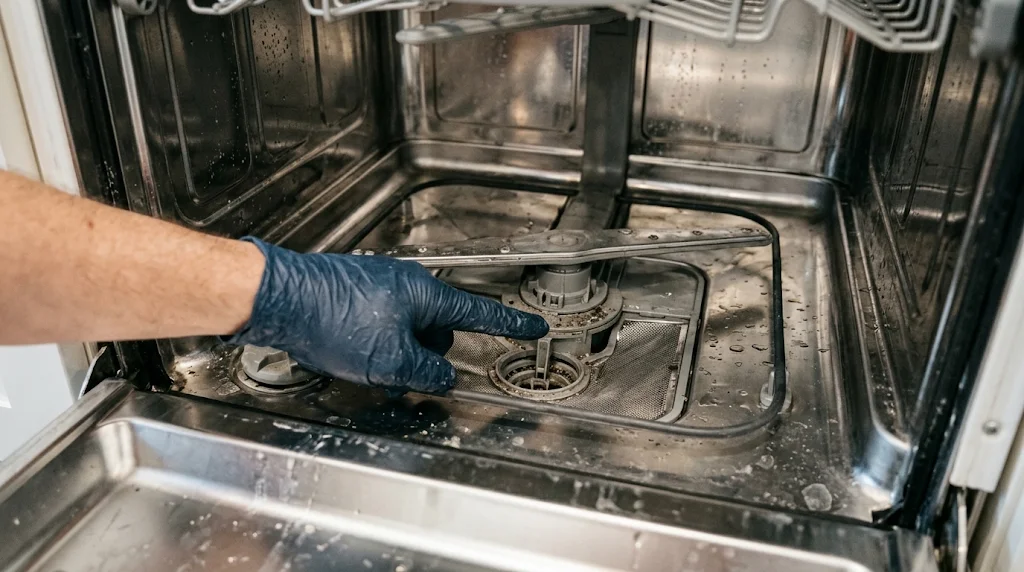
Safety: turn the dishwasher off and let the heating element cool before reaching into the bottom of the tub. Watch for broken glass in the filter area. Turn off power at the breaker and the water supply before removing any panel.
Dishwasher Maintenance Schedule to Keep Dishes Clean
| Task | How often |
|---|---|
| Rinse and check the filter | Every 2 to 4 weeks (weekly if you run it daily or do not scrape plates) |
| Clean the spray arms | Monthly, or whenever dishes come out gritty |
| Run a dishwasher cleaner or vinegar cycle | Monthly |
| Refill rinse aid | When the indicator shows, about every 3 to 4 weeks |
| Wipe the door gasket and door edge | Weekly |
| Check the drain hose and air gap | Every few months |
Repair or Replace a Dishwasher That Will Not Clean?
When a dishwasher isn’t cleaning because of a clogged filter, cracked spray arm, sticky dispenser latch, or bad inlet valve, repairing it is an easy call—those fixes cost a fraction of a new machine. Most residential dishwashers last 9 to 12 years. Our rule of thumb in the field: if your unit is under 8 years old and the repair runs less than half the price of a comparable replacement, fix it. If it’s past 10 years old and needs both a main wash motor and a control board, put that money toward a new dishwasher instead.
Helpful Dishwasher Guides: Fix standing tub water with our step-by-step dishwasher drainage troubleshooting guide, master rack placement with our complete dishwasher loading checklist, or explore brand-specific Bosch dishwasher repair in Los Angeles.
Dishwasher Still Not Cleaning Dishes?
CityFix Appliance Repair offers same-day dishwasher repair service backed by a 90-day parts and labor warranty, rated 5.0 ★ on Google.
Serving Glendale, Burbank & Greater Los Angeles from 201 N Brand Blvd, Suite 200, Glendale, CA 91203.
Dishwasher Not Cleaning Dishes: FAQ
Why is my dishwasher suddenly not cleaning dishes?
The most common cause is a clogged filter. Clean the filter and spray arms first, then check that the water is hot, the spray arms turn freely, and the detergent door opens.
Why are my dishes gritty after washing?
Grit usually comes from a dirty filter or blocked spray arms that recirculate food particles. Clean both, and scrape large food scraps off plates before loading.
Why is there a white film on my glasses?
White film and spots are usually hard water minerals or too much detergent. Use rinse aid, run a monthly dishwasher cleaner, and use the recommended amount of detergent.
Why is the detergent pod still in the dispenser after a cycle?
Something is blocking the dispenser door, the latch is sticking, or the cycle was rinse-only. Move tall items away from the door, clean the dispenser, and run a normal cycle. If the door still does not open, the dispenser needs repair.
Should I pre-rinse dishes before loading the dishwasher?
No. Scrape off large food scraps, but do not fully rinse. Modern detergents are designed to work on food soil, and pre-rinsing wastes water.
Does vinegar help a dishwasher that is not cleaning?
Yes, for mineral and grease buildup. Put a cup of white vinegar in an upright bowl on the top rack and run an empty hot cycle. It does not fix a clogged filter or a mechanical fault.
How often should I clean my dishwasher filter?
Every 2 to 4 weeks for most households, and weekly if you run the dishwasher daily or load dishes without scraping.
When should I call a technician for a dishwasher not cleaning?
Call when dishes are still dirty after cleaning the filter and spray arms, when you hear little water during the wash, when dishes come out cold, or when the dishwasher fills and drains but sounds weaker than before.


One Response