Quick answer: Scrape (don’t rinse) your dishes. Load plates, pots, and pans on the bottom rack, facing inward toward the center spray arm. Load glasses, mugs, and plastics on the top rack, angled downward. Alternate silverware up and down so nothing nests together. In Los Angeles, one more step matters more than anywhere else: keep rinse aid topped off, since hard tap water, not loading technique, is the most common reason “correctly loaded” dishes still come out spotty.
At CityFix Appliance, we get calls almost weekly from LA homeowners convinced their dishwasher is broken, when it’s actually a loading habit or the water itself. Here’s the complete breakdown.
Dishwasher Loading Cheat Sheet
| Zone | What Goes There | Key Rule |
|---|---|---|
| Bottom rack | Plates, pots, pans, cutting boards | Face inward, toward the center spray arm |
| Top rack | Glasses, mugs, small bowls, plastics | Angle downward, never straight up |
| Silverware basket | Forks, spoons, knives | Alternate up/down, never let same-size utensils nest |
| Third rack (if present) | Flatware, spatulas, measuring cups | Lay flat, spaced apart |
Does It Actually Matter How You Load a Dishwasher?
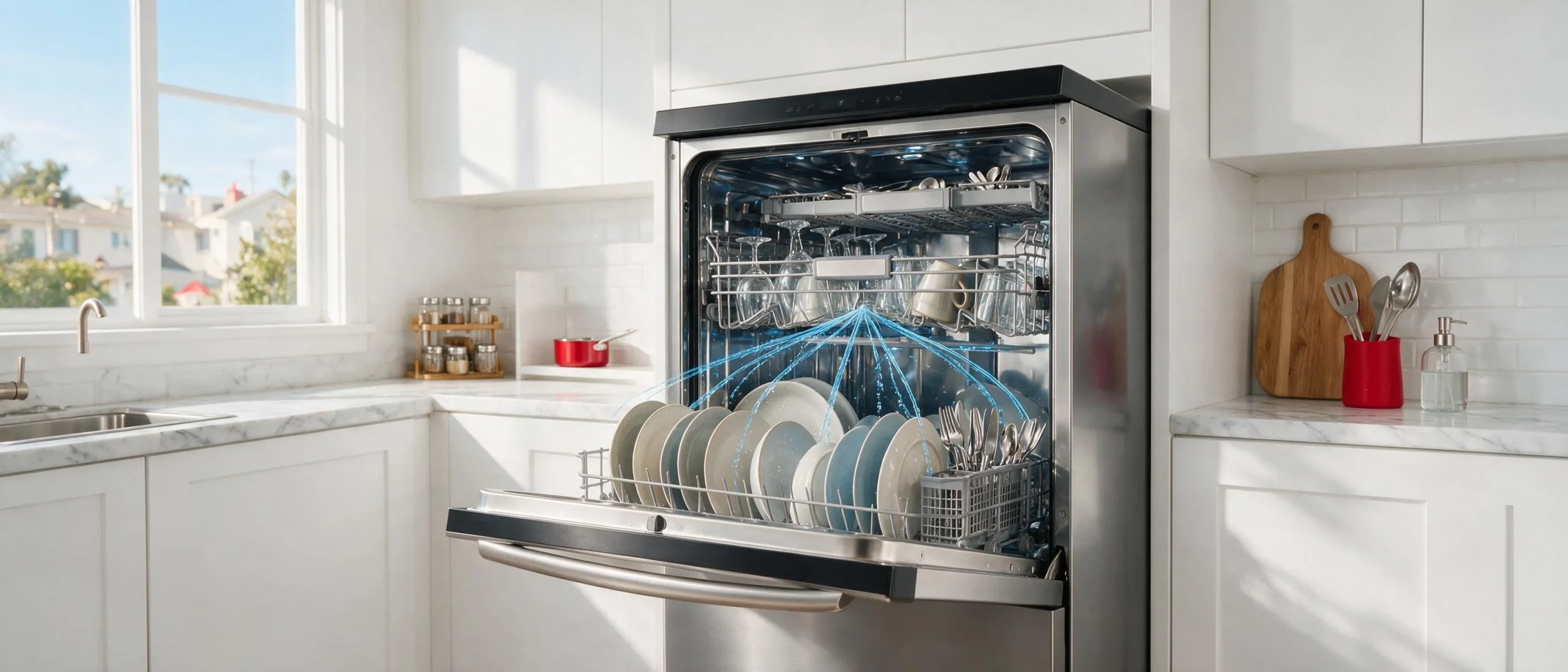
Yes, this is the most common question about dishwasher loading, and the answer is a clear yes. A dishwasher cleans through targeted water pressure, not soaking. Water sprays from fixed points at the bottom (and middle, on some models), bouncing off the interior walls to reach every angle. Block that spray path with poor placement, and water physically can’t reach the soiled surface, no matter how long the cycle runs.
How to Load the Bottom Rack
The bottom rack sits closest to the main spray arm and the heating element, the zone for anything large, sturdy, and heavily soiled.
- Plates and cutting boards: Face the dirty side inward. Space them apart; stacking or facing them all the same direction causes nesting, where water can’t reach the touching surfaces.
- Pots and pans: Place along the back and outer edges, angled downward for drainage.
- Keep the detergent door clear: A flat pan positioned in front of the dispenser can block it from opening mid-cycle, meaning your detergent never enters the wash.
How to Load the Top Rack
The top rack sits farther from the heating element, making it the ideal zone for delicate or heat-sensitive items.
- Glasses, cups, and mugs: Upside down, angled between the tines. Straight up, they trap water and dry into a spotted film.
- Small bowls: Angled downward toward the center spray path.
- Plastics: Top rack only; near the bottom heating element, they risk warping or melting.
Can You Put Bowls on the Bottom Rack?
Small and medium bowls generally belong on top, angled down so they don’t trap water. But large mixing bowls or serving bowls that don’t fit the top rack can go on the bottom; angle them downward along the back or side, facing the center spray arm, the same way you’d place a pot. What you want to avoid is bowls sitting flat and upright anywhere in the machine, since that traps standing water regardless of which rack they’re on.
How to Load Silverware
Alternate direction: Mix forks, spoons, and knives so they face both up and down. Same-size utensils nested together stay dirty. Knives point down for safety when unloading. Long utensils like spatulas and ladles lie flat on a top or third rack, never wedged where they can block a spray arm.
How to Load a Dishwasher with 2 Racks vs. 3 Racks
| Setup | What Changes |
|---|---|
| 2-rack (standard) | Keep tall items near the edges of the bottom rack so they don’t block the upper spray manifold |
| 3-rack (modern) | Top rack handles flatware and small items, freeing the main basket for wider plate spacing on the bottom |
A dedicated third rack – common on newer Bosch, Whirlpool, and Electrolux models- is built for flatware, spatulas, whisks, and small cups that are hardest to fit elsewhere.
Loading by Brand: Bosch, Whirlpool, Electrolux
Bosch:
- Known for a dedicated third-rack flatware tray and RackMatic® adjustable middle rack for taller items
- Load flatware flat, one utensil per slot where possible, with space between pieces
- Bosch recommends scraping (not rinsing) and facing dishes toward the center
Whirlpool:
- Features Folding Tines on select models for bulky bowls or irregular cookware
- Recommends loading back-to-front on both racks, unloading bottom-to-top so pooled water on upper-rack dishes doesn’t drip onto the dry lower rack
Electrolux:
- Typically uses a fixed lower rack for plates and cookware and an adjustable upper rack (raise or lower for tall glasses or stemware)
- Recommends angling cups and glasses downward and avoiding contact between items to prevent water-blocking
- Some models include a cutlery tray above the top rack, similar in function to a Bosch or Whirlpool third rack
Is There a Wrong Way to Load a Dishwasher? (7 Mistakes)
Yes – these are the mistakes that quietly ruin an otherwise “correct” load:
- Overcrowding — jamming the rack full to fit one more cycle’s worth of dishes leaves no open water channels, so jets glance off the outer layer of dishes and never reach what’s behind them.
- Nesting bowls or plates facing the same direction — two bowls stacked cup-to-cup, or plates all angled the same way- creates a sealed pocket that water simply can’t get into.
- Blocking the spray arms with a tall pot or oversized tray — the arm needs to spin freely through its full rotation; anything tall enough to catch it stops water from reaching everything downstream.
- Loading plastics on the bottom rack — sitting near the heating element, plastic containers and lids risk visible warping after just a few hot cycles.
- Skipping the scrape — large food chunks (bones, seeds, produce skins) clog the filter over time, which gradually reduces water pressure across every rack, not just where the debris landed.
- Blocking the detergent door with a flat pan — if the dispenser physically can’t flip open mid-cycle, none of your detergent ever enters the wash, and every dish comes out under-cleaned regardless of placement.
- Using too much detergent — more isn’t better; excess detergent leaves its own residue film, and in a hard-water city like LA, that film compounds with mineral spotting rather than canceling it out.
How to Load and Start a Dishwasher, Step by Step
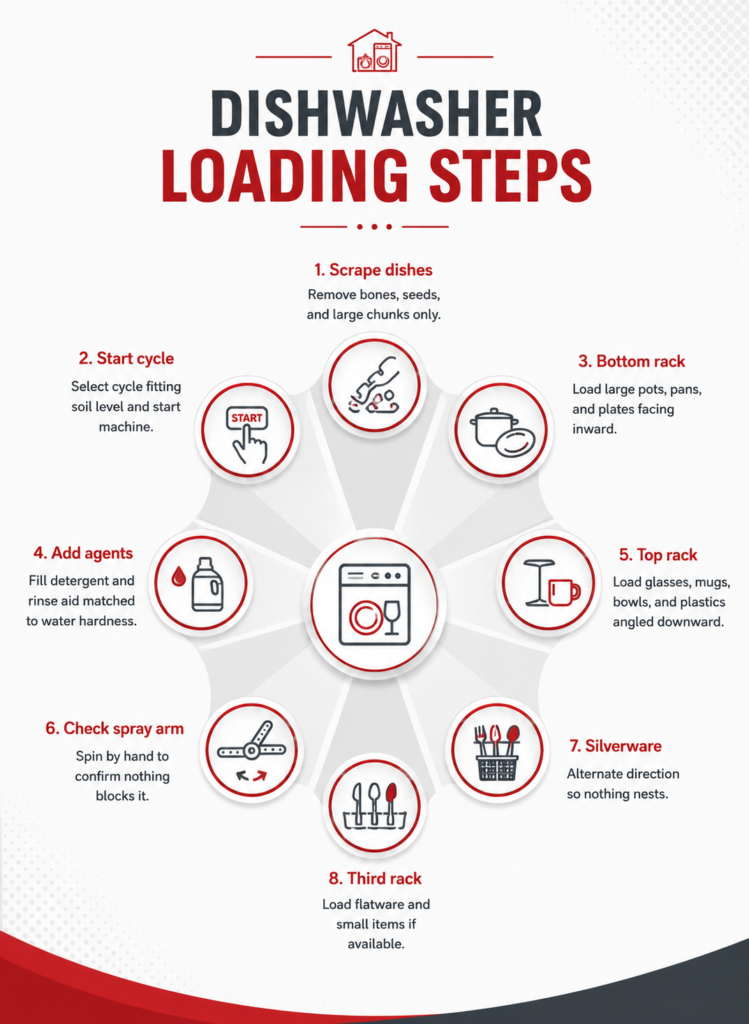
- Scrape (don’t rinse) each dish, remove bones, seeds, and large chunks only.
- Load the bottom rack first: large pots, pans, and plates, facing inward toward the center.
- Load the top rack: glasses, mugs, small bowls, and plastics, angled downward.
- Load silverware, alternating direction so nothing nests.
- Load the third rack, if you have one, with flatware and small items.
- Spin the spray arm by hand to confirm nothing blocks it.
- Fill detergent and rinse aid to levels matched to your water hardness.
- Select a cycle that fits your soil level, and start the machine.
Why LA Dishes Still Come Out Spotty
This is the step most guides skip — and it’s usually the real reason a correctly loaded cycle still leaves cloudy glasses. Los Angeles tap water commonly tests well into “hard water” territory, carrying high dissolved calcium and magnesium. As water evaporates during the dry cycle, those minerals stay behind on glass and dishware, leaving the chalky residue people usually blame on loading technique.
Three fixes address this directly:
- Keep rinse aid topped off — it lowers water’s surface tension so it sheets off glass instead of forming spot-leaving droplets.
- Clear mineral scale from the spray arm holes — hard water calcifies inside the tiny jets over time, choking pressure; a toothpick clears them.
- Match detergent to your water hardness rather than a generic scoop — too little underperforms, too much leaves film.
Nationally, an estimated 85% of U.S. households have hard or moderately hard water, and Los Angeles routinely tests above that national average. That’s why the same loading technique that works perfectly in a soft-water region can still leave visible spotting here; the rack placement was never the variable causing the problem.
If dishes are still dirty, wet, or the tub has standing water no matter how you load it, that’s mechanical: a clogged filter, a failing pump, or a dead heating element. That’s a repair, not a re-load.
That’s where we come in. CityFix Appliance repairs dishwashers across Los Angeles, often same-day. Visit our dishwasher repair page or appliancecityfix.com to book.
How to Load a Dishwasher Like a Pro: Optimal Cleaning Checklist
If you want every cycle to run at full efficiency, run through this before closing the door:
- Every dish scraped, not rinsed
- Nothing facing the same direction as its neighbor
- Spray arm spins freely when spun by hand
- Detergent door has a clear, unblocked path to open
- Rinse aid topped off (non-negotiable in Los Angeles)
- Cycle setting matches the actual soil level, not just “Normal” out of habit
Skipping any one of these is usually the difference between a load that looks clean and one that actually is.
FAQ
How are you actually supposed to load a dishwasher?
Plates and pots go on the bottom rack facing the center spray arm; glasses, mugs, and plastics go on top, angled downward; silverware alternates up and down to avoid nesting.
Is there a wrong way to load a dishwasher?
Yes, overcrowding, nesting items facing the same direction, and blocking the spray arms or detergent door are the most common mistakes.
Can I put bowls in the bottom of the dishwasher?
Small bowls belong on top. Large mixing or serving bowls that don’t fit up top can go on the bottom, angled downward toward the center, the same way you’d place a pot.
Does it matter how a dishwasher is loaded?
Yes. Dishwashers clean with targeted water pressure, not soaking; blocking the spray path with poor placement means water can’t reach the soiled surface no matter how long the cycle runs.
How do I load a dishwasher with 3 racks?
Use the top-most rack for flatware and small items like espresso cups, which frees up the main silverware basket and lets you space plates further apart on the bottom.
Why do my dishes still have spots after a full cycle?
In most Los Angeles homes, it’s hard water mineral residue, not a loading mistake. Rinse aid and clean spray arm holes fix most cases.
Conclusion
Loading a dishwasher correctly comes down to respecting the spray path, heavy items on the bottom facing center, delicate items on top angled down, utensils alternated, nothing blocking the arms or detergent door. In Los Angeles, add hard-water maintenance on top of that, and most “my dishwasher doesn’t clean” complaints disappear.
If yours is still struggling after all of this- not draining, not heating, or leaving standing water- that’s a repair, not a re-load. Book a dishwasher repair with CityFix Appliance, serving Los Angeles.