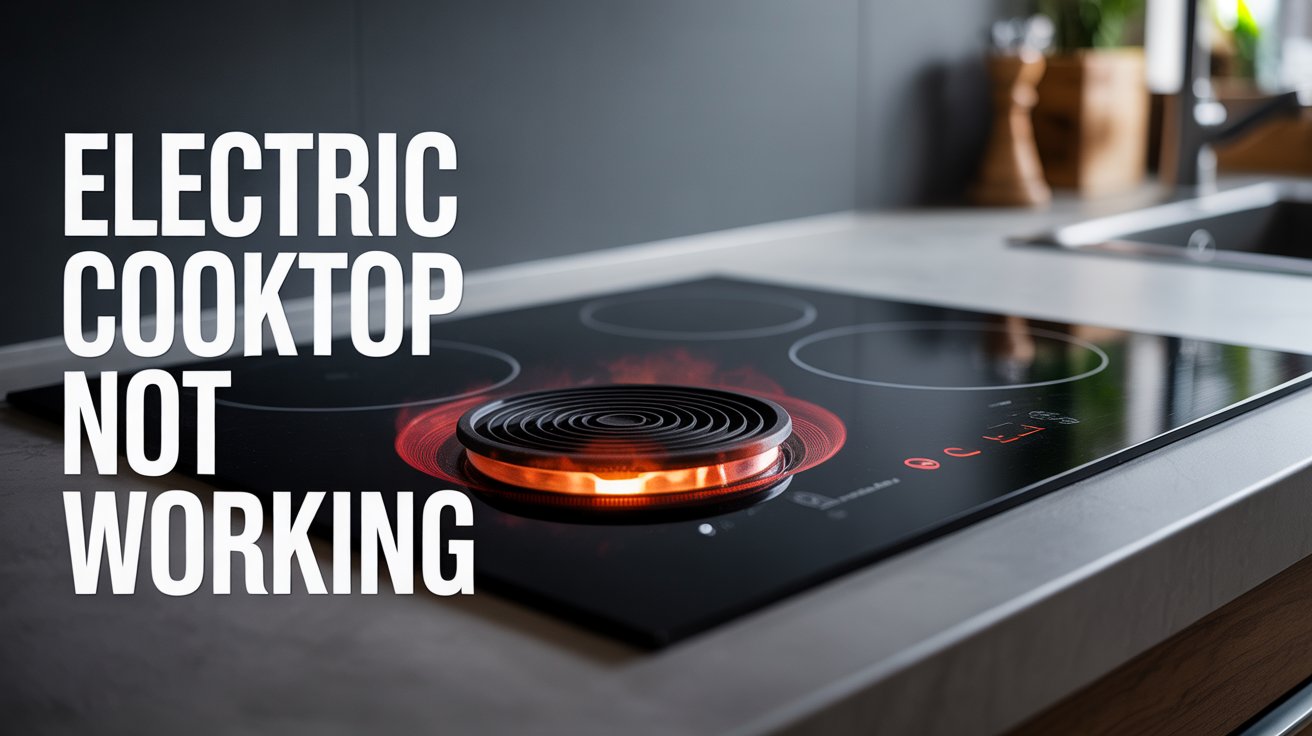
If your electric cooktop is not working, the problem almost always comes down to one of six fixable causes. Here’s how to identify which one, and what to do about it.
-
Quick Answer
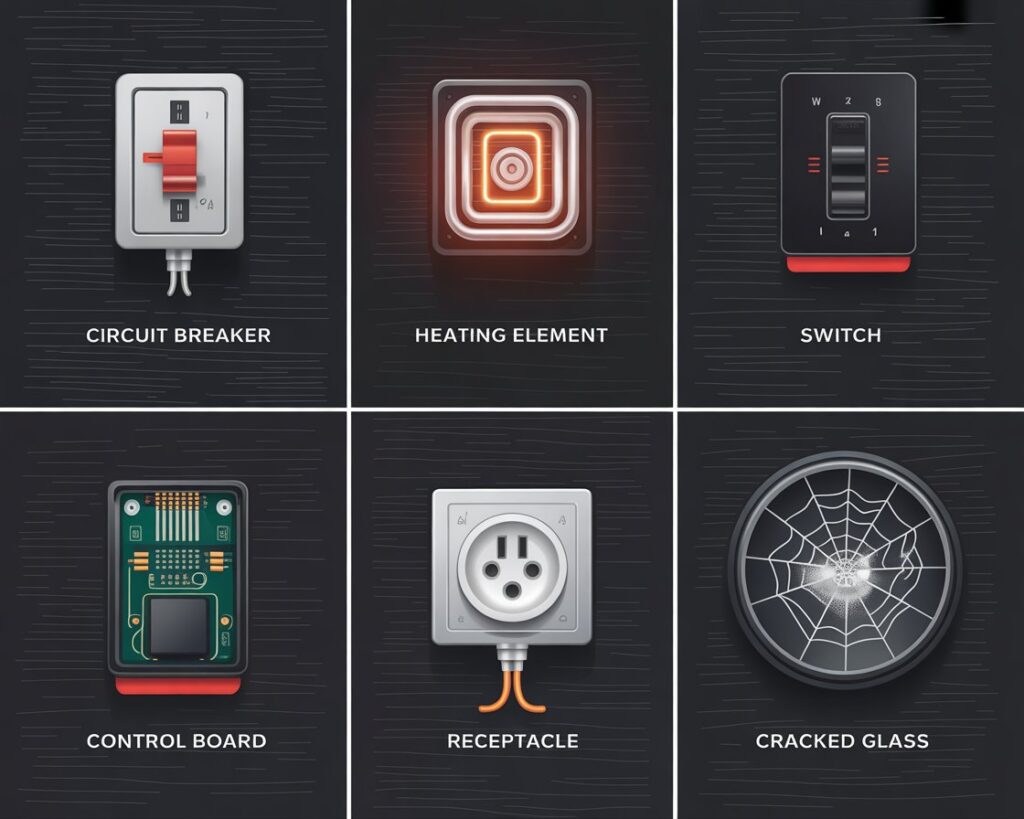
An electric cooktop stops working for one of six reasons:
- Tripped circuit breaker – the most common reason a cooktop goes completely dead
- Burned-out heating element – the usual suspect when a single burner stops heating
- Faulty infinite switch – causes a burner to quit entirely or get stuck at full blast
- Failed control board – common on induction and touch-control models, often shows up as an error code
- Damaged element receptacle – a loose or corroded socket that cuts power to the burner
- Cracked glass surface – disrupts heating on smooth-top models and creates a real safety hazard
The good news: most of these failures are fixable in a single visit, for far less than the cost of a new cooktop.
Why Is Your Electric Cooktop Not Working? Identify the Failure First
Before calling anyone, take thirty seconds to match your symptom to a likely cause. It points almost directly to the problem, and saves time and money for everyone involved.
| What you’re seeing | Most likely cause |
|---|---|
| Completely dead, nothing works | Tripped breaker or power supply fault |
| One burner out; everything else is fine | Burned-out element or faulty infinite switch |
| Burner stuck on high with no control | Failed infinite switch |
| Touch panel frozen or unresponsive | Control lock is on, or the control board has failed |
| Error code flashing; cooktop keeps shutting off | Control board or temperature sensor |
| Works some days, not others | Loose receptacle or worn-out switch |
| Visible crack in the glass | Stop using it immediately |
The 6 Most Common Reasons an Electric Cooktop Is Not Working
1. Tripped Circuit Breaker
Your electric cooktop runs on a dedicated 240-volt double-pole breaker, double the voltage of a normal outlet. A power surge, an aging breaker, or a wiring issue can trip it without warning.
Here’s what catches people off guard: a half-tripped breaker still looks like it’s in the “on” position. You check the panel, everything looks fine, and you assume the cooktop itself has died. Nine times out of ten, the breaker just needs a proper reset.
What to do: Find the double-pole breaker labeled “cooktop,” “range,” or “kitchen.” Push it all the way to OFF, then firmly back to ON. If it trips again right away, stop. That’s a sign of a fault inside the cooktop or your home’s wiring, and it needs a technician.
2. Burned-Out Heating Element
The heating element is what actually makes heat, either an exposed coil or a radiant element sitting under the glass. After years of constant heating and cooling cycles, it eventually fails.
On a coil cooktop, you can often see the damage: a break, a blister, or a dark burned spot. On a smooth-top, the element fails silently under the glass, the only sign is that the burner simply stops working. This is one of the most common reasons a single burner on an electric cooktop is not working while everything else functions normally.
The fix is one of the most straightforward repairs in the business. Most technicians carry common elements on the truck and handle it in a single visit.
3. Faulty Infinite Switch
The infinite switch is the component behind your burner dial. It controls exactly how much power flows to the element, which is how you get everything from a gentle simmer to a rolling boil.
When it fails, you’ll typically see one of three things: the burner does nothing at all (even though the element is fine), it runs wide open with no way to turn it down, or it behaves erratically, cycling on and off, responding slowly, or acting unpredictably.
This one gets misdiagnosed constantly. Because the burner isn’t heating, people assume the element is the problem and replace it first. When that doesn’t fix it, they’re back to square one. A proper diagnosis checks both components before anything gets ordered.
4. Failed Control Board
On modern electric and induction cooktops, the control board is the brain of the whole operation. Temperature control, safety shutoffs, heating zone management, it all runs through this one component.
When the board fails, symptoms can look like almost anything: touch controls that won’t respond, error codes cycling through the display, zones that won’t heat even though the unit powers on, or the cooktop shutting itself off mid-cook.
Important: Don’t guess on this one. Confirming a control board fault requires proper diagnostic tools. Replacing the board based on a hunch, and then discovering it wasn’t the problem, is one of the most expensive mistakes you can make in a DIY repair.
5. Damaged Element Receptacle
On coil-type cooktops, each heating element plugs into a socket called a receptacle. Years of heat, vibration, and expansion cycles take their toll, the socket loosens, contacts corrode, or the connection point burns out. When that happens, power to the element becomes unreliable or stops completely.
What makes this tricky: the element itself tests perfectly fine. The problem is at the connection, and you won’t find it without a hands-on inspection. It’s also the most common explanation for an electric cooktop that works intermittently, running fine one day and failing for no obvious reason the next.
6. Cracked Glass Surface
The glass-ceramic surface on a smooth-top cooktop serves two purposes: it’s your cooking surface, and it’s the protective barrier over the electrical elements underneath. A crack, even a hairline one, breaks that seal.
Once compromised, moisture and food debris can reach the components below. That’s a shock hazard, full stop. Heat distribution also becomes uneven, but the safety issue is the real concern here.
⚠️ Safety warning: If your glass surface is cracked, stop using the cooktop immediately. Get it inspected before your next meal. Glass panel replacement is often far more affordable than people expect, and almost always less expensive than buying a new unit.
What You Can Check When Your Electric Cooktop Is Not Working – and Where to Stop
Safe to do Yourself
- Confirm the unit is actually getting power
- Reset the circuit breaker once (not repeatedly)
- Check whether the control lock was accidentally switched on, check your manual before assuming something is broken
- Look for obvious physical damage like cracks or burn marks
Leave This to a Technician
- Accessing internal components without cutting power at the breaker
- Replacing or bypassing the control board
- Any wiring work inside the unit
- Diagnosing induction cooktop problems without specialized tools
This isn’t overly cautious advice, it’s practical. Electric cooktops run at 240 volts. For anything beyond a breaker reset or a visual check, call a professional.
Repair or Replace? Here’s How to Think About It
A good technician will help you answer this question at the point of diagnosis, not before they’ve looked at the unit, and not after the repair is already done. Here’s the framework:
| Factor | Points toward repair | Points toward replacement |
|---|---|---|
| Age | Under 8–10 years | 12+ years with a history of problems |
| Type of failure | Single element, switch, or receptacle | Control board failure in an older unit |
| Cost vs. replacement | Under 50% of a new unit’s price | 60%+ of what a comparable new unit costs |
| Glass damage | One crack; panel is available | Severe damage or discontinued parts |
| Technology | Current unit still serves you well | Older coil cooktop; ready to upgrade |
Here’s the math: a new electric cooktop in the LA market runs anywhere from $400 to $1,500+, depending on brand and type. Replacing a single element, switch, or receptacle costs a small fraction of that. For a cooktop under ten years old with one clear, identifiable failure, repair wins financially – almost every time.
What a Good Repair Visit Actually Looks Like
It’s worth knowing what a professional service visit should include, so you can tell immediately if the person at your door isn’t measuring up.
- A real arrival window – two hours, with a call thirty minutes out. Not “sometime between 8 and 5.”
- Diagnosis before pricing – a technician who quotes you over the phone before seeing the unit is guessing.
- A clear explanation – you should know exactly what failed, why it likely failed, and what the repair involves.
- Flat, upfront pricing – no surprises when the invoice comes.
- Same-day repair when possible – most common failures are handled on the first visit with parts already on the truck.
- A written warranty – any reputable shop backs their work in writing.
- An honest replacement recommendation – if the repair doesn’t make financial sense, you should hear that directly, not after money has already changed hands.
Electric Cooktop Not Working in Greater LA?
CityFix Appliance offers same-day electric, gas, and induction cooktop repair across Los Angeles, Glendale, Burbank, Pasadena, and 70+ cities throughout the Greater LA area.
📞 (818) 937-1818 · 90-day parts & labor warranty · Upfront flat pricing · No fix, no charge
Why LA Cooktops Fail More Often Than You’d Think
It’s not just age and use, local conditions in Greater Los Angeles genuinely accelerate appliance wear. Older homes in Silver Lake, Echo Park, and parts of the San Fernando Valley were built before 1980. Aging electrical infrastructure creates voltage irregularities that stress components over time. Coastal moisture in Santa Monica, Culver City, and the South Bay quietly corrodes electrical contacts and element receptacles. High rates of home cooking and heavy use in multi-unit buildings add up quickly.
A technician who knows this market will give you a more accurate diagnosis, and a more realistic picture of what your appliance has left in it, than a national dispatch center ever could.op repa
Frequently Asked Questions: Electric Cooktop Not Working
How do I reset an electric cooktop?
To reset an electric cooktop, turn off the unit and switch the circuit breaker fully to OFF, then back to ON. Many cooktops run on a 240-volt double-pole breaker, which can appear “on” even when it’s tripped. A proper reset often restores power immediately. If the breaker trips again, it indicates an internal fault that requires professional repair.
Can electric cooktops be repaired?
Yes, most electric cooktop issues are repairable and usually fixed in a single visit. Problems like a burned-out heating element, faulty infinite switch, or damaged receptacle are straightforward repairs and cost significantly less than replacing the entire unit. Even some control board issues can be repaired depending on the model and age.
What are the two most common problems in an electric stove?
The two most common problems are:
- Tripped circuit breaker – the leading cause when the cooktop is completely dead
- Burned-out heating element – the most common reason a single burner stops working
Both issues are easy to diagnose and typically quick to fix.
How to fix an electric induction cooktop?
Start by checking power supply and ensuring the unit isn’t locked or showing an error code. Induction cooktops rely heavily on the control board, so failures often involve electronics rather than simple parts. Because proper diagnosis requires specialized tools, most induction cooktop repairs should be handled by a technician to avoid costly mistakes.
Why is my cooktop suddenly not working?
A cooktop usually stops working due to one of six key issues:
- Tripped circuit breaker
- Burned-out heating element
- Faulty infinite switch
- Failed control board
- Damaged element receptacle
- Cracked glass surface
Matching the symptom (e.g., completely dead vs. one burner not working) helps pinpoint the exact cause quickly.
What causes induction cooktop failure?
Induction cooktops typically fail due to:
- Control board malfunction
- Power supply issues or voltage irregularities
- Overheating or internal sensor faults
- Electrical wear over time
Unlike traditional electric cooktops, most induction failures are electronic and require accurate diagnosis before repair.
The Bottom Line
If your electric cooktop is not working, there’s a very good chance it’s fixabl, quickly, affordably, and without replacing the unit. Identify your symptom, reset the breaker if that applies, and get a technician out before a simple problem turns into a more expensive one.
For any cooktop under ten years old with a single, identifiable failure, repair is almost always the right move, financially and practically.